What Is Actually Causing Your Acne
Most acne begins with a blocked pore, oil and dead skin cells trapping bacteria beneath the surface, which is why comedonal acne, blackheads and whiteheads responds well to topical treatment alone. Inflammatory and cystic acne go a step further, with deeper bacterial involvement and inflammation that sits below the skin and often needs an oral medication to control from the inside.
Hormonal acne is its own category entirely, typically appearing along the jawline and chin, flaring around the menstrual cycle, and resistant to standard topical treatment because the trigger is internal rather than something sitting on the skin's surface. Adult acne, breakouts that continue or start well past the teenage years, is frequently hormonal in nature and needs to be treated as such rather than with the same regimen given to a fifteen year old.
When to See a Dermatologist Instead of Waiting It Out
Over the counter products containing benzoyl peroxide or salicylic acid can genuinely help mild acne, but they need a fair trial, typically six to eight weeks of consistent use, before you can judge whether they are working. If breakouts have not improved after that window, or if you are dealing with painful cystic bumps that sit under the skin rather than surface pimples, that is a clear signal to move past over the counter options. Acne that is already leaving marks or scars behind, or that has persisted for months without change, is also worth addressing sooner rather than later, since active acne can continue creating new scarring for as long as it goes untreated.
Our Treatment Approach
Every acne consultation at DermaTales begins with identifying the type and grade of acne you actually have, since comedonal, inflammatory, cystic, and hormonal acne all call for a different starting point. Skin type, breakout pattern, and any previous treatments already tried are reviewed so the plan does not repeat something that has already failed.
From there, a treatment plan is built and adjusted at follow up visits based on how your skin is actually responding, rather than staying fixed to a single package regardless of progress.
Treatment Options We Offer
01
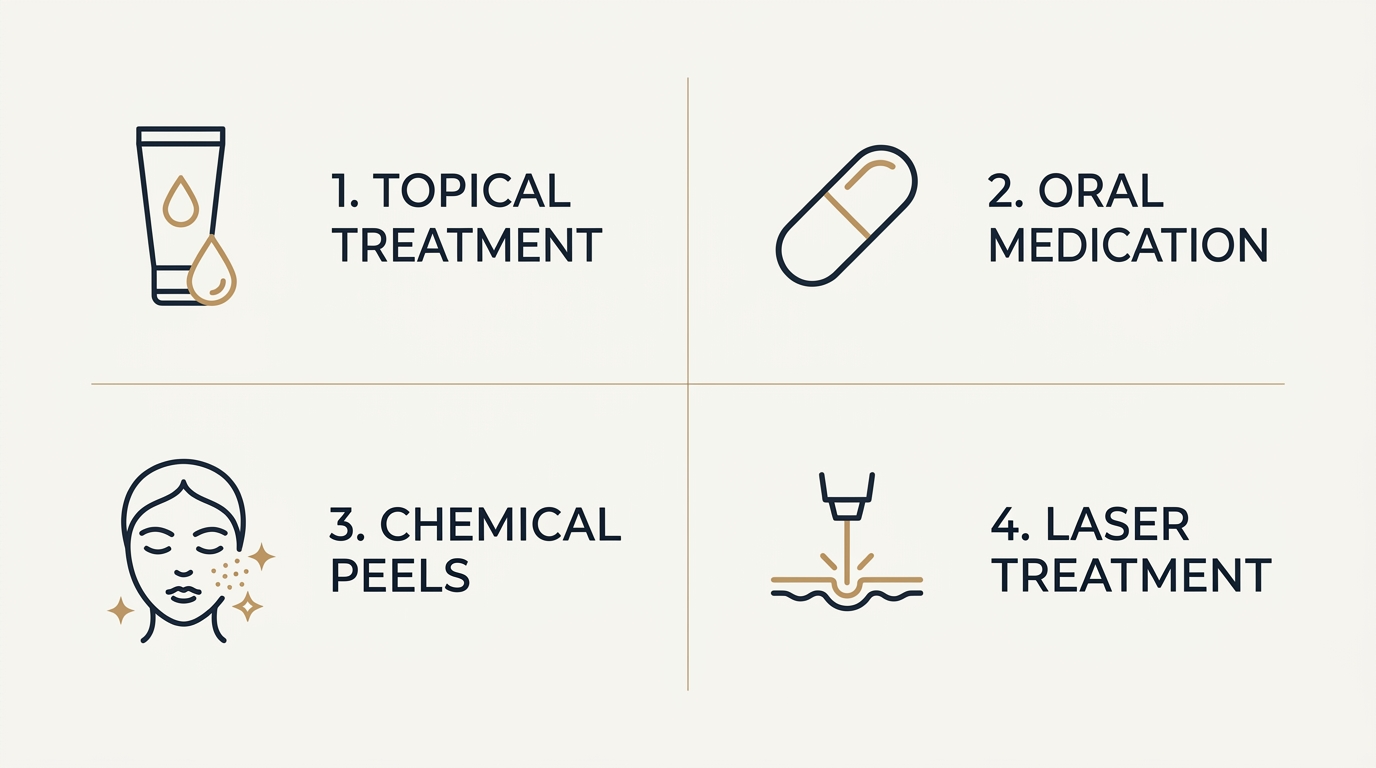
Topical Prescription Treatment
Retinoids, topical antibiotics, and other prescription strength actives address clogged pores and surface bacteria more effectively than over the counter versions, and are the starting point for mild to moderate acne.
02
Oral Medication
For inflammatory or cystic acne that is not responding to topical treatment alone, oral antibiotics or hormonal treatments address the deeper or internal drivers of breakouts. Isotretinoin is reserved for severe, treatment resistant acne and is only prescribed after a detailed medical review, since it carries specific precautions that need to be discussed directly with your dermatologist.
03
Chemical Peels
Peels help manage active breakouts alongside the surface pigmentation acne often leaves behind, and are commonly used as a supporting treatment rather than a standalone fix for active cystic acne.
04
Laser and Light Based Treatment
Laser therapy can reduce inflammation and bacterial activity in more resistant acne, generally used alongside topical or oral treatment rather than replacing it. For pigmentation left behind after breakouts settle, our Pico Laser Treatment page covers this in more depth.
Most acne treatments, whether topical or oral, need six to eight weeks before any real improvement is visible, and full results are usually judged closer to the three month mark. It is common for skin to look slightly worse in the first two to four weeks of starting a new retinoid or prescription treatment, a temporary phase often called purging, before it improves. This is expected and discussed in advance so it does not feel like the treatment failing.
Hormonal acne in particular can take a full menstrual cycle or two before a clear pattern of improvement shows up, since the treatment is working with a slower internal process rather than a surface level fix.
Cost of Acne Treatment in Delhi
Acne treatment cost depends on whether your plan involves topical prescriptions alone, oral medication, in office procedures, or a combination, and how many follow up visits your case needs to stay on track. A straightforward topical regimen costs differently than a plan involving oral isotretinoin with monitoring, or one that adds peels or laser sessions.
At DermaTales, your actual costing is discussed after your consultation, once your specific treatment plan and monitoring needs are known.
Why Choose DermaTales for Acne Treatment in Delhi
Acne that keeps coming back despite consistent effort is usually a sign that the underlying cause was never correctly identified in the first place.
- Acne type and grade properly identified before any treatment is prescribed
- Plans adjusted at follow up visits based on actual skin response, not fixed regardless of progress
- Hormonal and adult acne addressed as a distinct category rather than treated like teenage acne
- Care supervised by Dr. Pooja Varshney, MD Dermatology
- Located in Patel Nagar, accessible for patients across Central Delhi including Karol Bagh, Rajinder Nagar, and Punjabi Bagh
- If old breakouts have already left marks or pitting behind, our Acne Scar Treatment and Acne Scar Surgery pages cover non surgical and surgical options once active acne is under control.

TAKE THE NEXT STEP
Book Your Permanent Acne Treatment Consultation in Delhi
DermaTales, Patel Nagar
If your acne has not responded to over the counter products, or you suspect a hormonal or adult acne pattern that needs a different approach, a proper consultation can identify what is actually driving your breakouts. Book an appointment with Dr. Pooja Varshney at DermaTales, Patel Nagar for a diagnosis led treatment plan built around your skin.
Frequently Asked Questions
Most treatments need six to eight weeks before visible improvement, with full results usually evident around the three month mark. Consistency matters more than any single product or session, since skin renewal itself takes time.
Often yes, particularly in the first two to four weeks of starting a retinoid or new prescription treatment, a temporary reaction known as purging. This is expected and different from the treatment not working, and is explained clearly before you start so it does not come as a surprise.
Hormonal acne, typically along the jawline and chin and tied to the menstrual cycle, often does not respond to standard topical treatment alone since the underlying trigger is internal. It usually needs a treatment approach that addresses the hormonal driver directly rather than only treating the skin's surface.
Isotretinoin is reserved for severe, treatment resistant cystic acne that has not responded to other options, and is prescribed only after a detailed medical review since it carries specific precautions, including strict guidance around pregnancy. This is discussed in full detail with your dermatologist before it is ever considered.
Adult acne is very treatable, though it is frequently hormonal in nature and needs to be approached differently from the acne treatment given to teenagers. Identifying that distinction early usually makes a meaningful difference in how quickly it responds.
Yes, and this is one of the most important reasons to treat active acne early rather than waiting. Ongoing inflammation is what creates new scarring, so controlling breakouts sooner reduces the chance of scars forming in the first place.