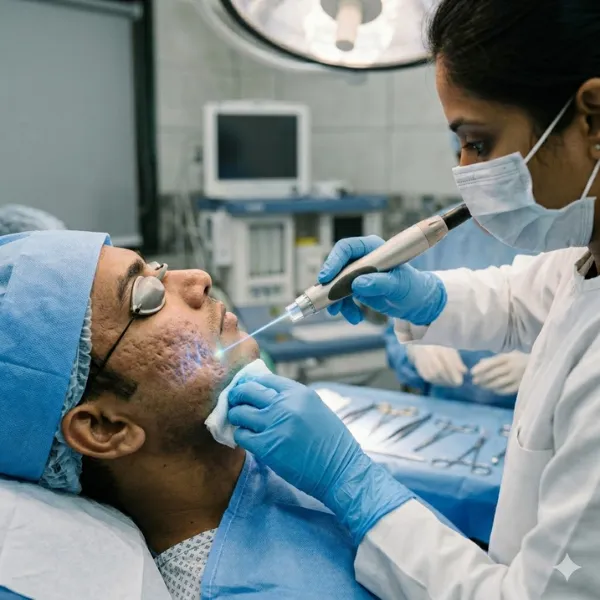
Acne Scar Surgeries in Delhi, Patel Nagar
Some acne scars sit too deep for a peel or a laser session to touch. Ice pick scars, boxcar scars, and
tethered rolling scars are held down by fibrous bands under the skin, and no amount of resurfacing on
the surface will release what is pulling the skin down from underneath. These scars need a surgical
release first, and resurfacing after. At DermaTales in Patel Nagar, Delhi, acne scar surgery is planned
around that exact principle under the supervision of Dr. Pooja Varshney, MD Dermatology.
Why Some Acne Scars Need Surgery, Not Just Resurfacing
Acne scars form differently depending on how the original inflammation damaged the skin.
01
Boxcar Scars
Have vertical, sharply defined edges because
collagen was destroyed evenly across a wide area. No amount of surface resurfacing can rebuild what
was lost beneath the skin.
02
Ice Pick Scars
Are narrow and deep because the inflammation
tunnelled straight down into the dermis. The narrow opening means peels cannot reach the depth where
the damage actually sits.
03
Rolling Scars
Look shallow on the surface but are actually
being pulled downward by a fibrous band anchored to the tissue beneath. Only a surgical release can
free what is pulling the skin down.
This is exactly why patients who have already tried multiple courses of chemical peels or microneedling
with limited results are often not failing to respond to treatment. They are being treated with the wrong
category of treatment. Surface level procedures cannot release a tethered band or rebuild a
missing pit of
tissue. Surgery can.
When Surgical Correction Is the Right Next Step
If scars have been present for over a year and have not visibly softened despite consistent peels,
microneedling, or laser sessions, that is a signal worth acting on rather than repeating the same
protocol. Patients who can feel a scar tug or pucker when they smile or move their face are usually
dealing with tethering, which needs release before anything else works. Deep ice pick or boxcar scars
that
create visible shadowing under normal light, especially in photographs, are also strong candidates for
surgical correction rather than continued resurfacing alone.
Our Treatment Approach
Every acne scar surgery at DermaTales begins with a scar mapping consultation, not a standard package.
Under magnified lighting, each scar is individually assessed for depth, type, and whether tethering is
present. Skin type and healing history are also factored in, since darker skin tones carry a higher risk
of post-inflammatory pigmentation if the wrong technique is used. Based on this assessment, a
combination protocol is designed.
Most patients with mixed scar types need more than one technique to see meaningful improvement. In
clinical studies comparing approaches, combination treatment has shown notably higher improvement rates
than any single technique used alone, which is why that combination is decided in advance rather than
adjusted session to session.
Surgical Techniques We Use
01
Subcision
A fine needle is used to release the fibrous bands tethering rolling scars to the tissue below. Once released, the skin can sit at its natural level again instead of being pulled down, and the treated area is often followed with volume replacement to support the released tissue.
02
TCA CROSS
A focused, high concentration trichloroacetic acid application is placed directly into the base of ice pick and narrow boxcar scars using a fine applicator. This stimulates collagen at the exact site of the scar without affecting the surrounding skin, and typically needs to be repeated across several sessions spaced weeks apart.
03
Punch Excision & Punch Grafting
Deep, narrow scars that are unlikely to respond to resurfacing are surgically removed using a small circular punch tool. Depending on the scar, the site is either closed directly or grafted with skin from another area, allowing it to heal flat instead of pitted.
04
Combination Laser Resurfacing
Once surgical correction has addressed the depth and tethering, pico laser or fractional resurfacing is often used in a later session to refine surface texture and even out tone across the treated area.
Acne scar surgery is priced per session and depends on the number of scars being treated, the specific techniques combined for your scar pattern, and how many sessions your case requires overall. A single ice pick scar treated with TCA CROSS costs differently than a full cheek of tethered rolling scars needing subcision and grafting. At DermaTales, cost is only discussed after your scar mapping consultation, once your exact treatment plan is known, so you are working with real numbers rather than a generic package price.
Subcision results build gradually as the released skin settles and any added volume integrates, usually visible over 4 to 6 weeks. TCA CROSS needs multiple sessions spaced roughly a month apart, with visible softening typically after the second or third session. Punch excision and grafting sites take a few weeks to heal before their final texture is evident. Most patients need three to six sessions spaced four to six weeks apart to see their full result, and this timeline is discussed clearly during the consultation so expectations are set before you begin.
Why Choose DermaTales for Acne Scar Surgery in Delhi
Acne scars do not respond to a one size fits all approach, and treating them like they do is usually why
previous treatments have not worked. DermaTales builds a scar specific plan for every patient before any
procedure begins.
- Scar type mapping under magnification before any technique is chosen.
- Combination protocols designed for mixed scar patterns, not single treatment packages.
- Techniques selected with skin tone in mind to reduce pigmentation risk.
- Surgical correction performed under Dr. Pooja Varshney, MD Dermatology.
- Located in Patel Nagar, accessible for patients across Central Delhi including Karol Bagh, Rajinder Nagar, and Punjabi Bagh.
For non-surgical options or milder scarring, our Acne Scar Treatment page covers peels and
microneedling based approaches, and our Acne Treatment page addresses active breakouts
before scarring occurs.
Frequently Asked Questions
Local anaesthesia is used for subcision, TCA CROSS, and punch excision, so the procedures themselves
are not painful. Swelling and mild bruising in the treated area for around seven to ten days
afterward is normal and usually settles with simple aftercare, and most patients return to daily
activities almost immediately.
This depends on scar type and number, though most patients need three to six sessions spaced four to
six weeks apart. A few isolated ice pick scars may need three to four TCA CROSS sessions, while
widespread tethered scarring often needs a combination of subcision, grafting, and later resurfacing
across several months.
Mild swelling and bruising in the first week can temporarily make treated areas look more prominent,
which is expected and not a sign of a poor outcome. Genuine worsening is rare when the technique is
matched correctly to your scar type, which is exactly why scar mapping and technique selection
happen before treatment rather than being decided on the spot.
When performed correctly on well selected candidates, subcision and TCA CROSS do not leave visible
marks. Punch excision sites are small and are closed or grafted specifically to heal flat, which is
discussed in detail during your consultation.
Yes, and for many patients this combination gives a meaningfully better result than either approach
alone. Surgical techniques address depth and tethering, while a later laser session refines surface
texture once the skin has healed from the surgical stage.
Yes, but technique selection matters more for darker skin tones due to a higher risk of
post-inflammatory pigmentation. This is specifically assessed during your scar mapping consultation
before any technique is chosen.
TAKE THE NEXT STEP
Book Your Acne Scar Consultation
DermaTales, Patel Nagar
If peels and lasers alone have not moved your acne scars, a surgical assessment can tell you whether tethering or depth is the reason why. Book an appointment with Dr. Pooja Varshney for a scar mapping consultation and a treatment plan built for your specific scars, not a generic one.
Medical Grade Hygiene
Transparent Pricing
Doctor Supervised