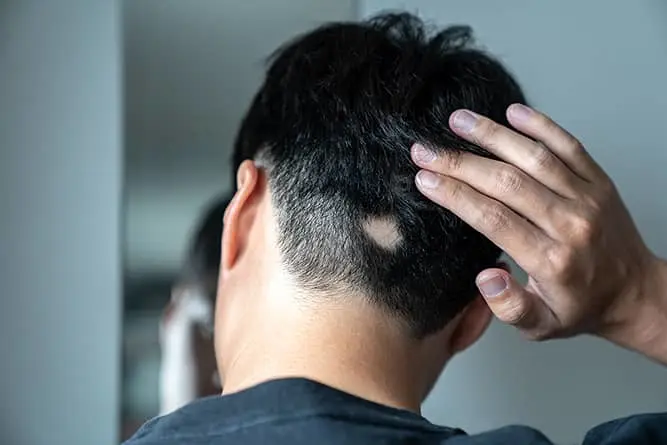
Alopecia Areata Treatment in Delhi, Patel Nagar
A round, smooth bald patch that appeared suddenly, with no thinning or shedding leading up to it, behaves
very differently from ordinary hair fall and needs a different explanation. Alopecia areata is an
autoimmune condition where the immune system temporarily attacks hair follicles, and while it can look
alarming, it is not scarring and the follicles themselves are not destroyed. At DermaTales in Patel Nagar,
Delhi, alopecia areata is diagnosed carefully before treatment begins, under the supervision of Dr. Pooja Varshney, MD Dermatology.
Hair follicles remain alive beneath the scalp; regrowth is medically possible with timely intervention.
Dermoscopic evaluation distinguishes alopecia areata from fungal infections or scarring hair disorders.
Intralesional micro-injections, PRP cellular therapy, and targeted systemic regimens matched to patch severity.
What Is Actually Happening
In alopecia areata, the immune system mistakenly targets hair follicles in specific areas, halting hair
growth without permanently destroying the follicle itself. This is what makes the condition different from
scarring forms of hair loss, where regrowth is often no longer possible. It is also frequently linked to
other autoimmune conditions, including thyroid disorders and vitiligo, which is why a proper workup
sometimes looks beyond the scalp itself.
One detail worth knowing is that a patchy bald spot is not automatically alopecia areata. Fungal
infections of the scalp can produce a similar looking patch, and telling the two apart matters, since one
needs immune modulating treatment and the other needs an antifungal. Our Fungal Infection
Treatment page covers scalp fungal infections separately, and a clinical examination, sometimes
supported by trichoscopy, is what distinguishes between the two before any treatment is started.
| Condition |
Scalp Surface |
Hair Characteristics |
Core Medical Approach |
| Alopecia Areata |
Smooth & Non-Scaly |
Exclamation point hairs at borders |
Intralesional steroids, PRP & immunomodulation |
| Fungal Infection (Tinea) |
Flaky, Scaly, Redness |
Broken hair stumps & black dots |
Targeted topical & oral antifungals |
| Scarring Alopecia (LPP) |
Fibrotic & Loss of Pores |
Perifollicular erythema & scaling |
Urgent anti-inflammatory therapy to halt loss |
When to Seek Immediate Clinical Treatment
A single small patch that appeared recently is worth having assessed promptly, since earlier treatment is
generally associated with a better response than waiting months after onset. Multiple patches, patches
that are enlarging, or hair loss extending to the eyebrows, eyelashes, or beard area are also reasons to
seek a dermatologist rather than home remedies, which have no meaningful evidence behind them for this
condition. If hair loss is extensive, covering most of the scalp or progressing toward total scalp or body
hair loss, prompt specialist input matters even more, since these more extensive forms are known to be
harder to treat the longer they are left unaddressed.
Our Treatment Approach
Diagnosis at DermaTales starts with a clinical scalp examination and trichoscopy to confirm the pattern is
consistent with alopecia areata rather than another cause of patchy hair loss. Depending on the extent of
involvement and your history, blood tests may be recommended to check for associated thyroid or other
autoimmune activity. Once confirmed, treatment is matched to how much of the scalp is affected, since
localized patches and extensive or rapidly progressing disease are approached differently, and the plan is
reviewed at follow up visits based on your actual regrowth response.
Step 1: Clinical Trichoscopy & Scalp Mapping
High-magnification digital dermoscopy to inspect follicular ostia, yellow dots, black dots, and pathognomonic exclamation-mark hairs.
Step 2: Underlying Autoimmune Investigation
Evaluating potential systemic triggers including thyroid autoantibodies, ferritin, vitamin levels, and overall immune profile.
Step 3: Personalized Regrowth Protocol
Administering targeted intralesional micro-injections (ILAC), topical immunomodulators, or regenerative PRP therapy.
Step 4: Regrowth Tracking & Relapse Prevention
Follow-up clinical reviews every 4–6 weeks to monitor the transition of fine vellus hair into healthy, pigmented terminal hair.
Treatment Options We Offer
Because alopecia areata varies in severity from mild solitary spots to widespread shedding, treatments are customized to the stage and speed of disease progression:
Intralesional Corticosteroid Injections
Small micro-injections of targeted anti-inflammatory corticosteroid directly into patches to halt immune attack and reactivate dormant follicle bulbs.
Protocol
Direct follicular delivery
Interval
Every 4 to 6 weeks
Early Regrowth
Visible in 4–8 weeks
Topical and Oral Medication
Prescription topicals or Minoxidil used alongside injections to sustain growth, with supervised short systemic courses for rapid active patch expansion.
Topicals
Potent solutions + Minoxidil
Systemic Control
Supervised short courses
Role
Sustained barrier & density
PRP Therapy (Platelet-Rich Plasma)
Enriched autologous growth factors injected into thinning borders to improve microvascular nourishment and accelerate follicular recovery naturally.
Mechanism
Concentrated growth factors
Nature
100% natural & non-steroidal
Benefit
Vascular follicular support
Advanced Systemic & JAK Options
For alopecia totalis, universalis, or treatment-resistant cases, newer targeted oral pathways (including JAK inhibitors) are evaluated by our specialist.
Indication
Totalis / Universalis / Resistant
Therapy
Targeted pathway modulation
Supervision
Close clinical monitoring
Cost of Alopecia Areata Treatment in Delhi
Cost depends on the extent of hair loss, whether treatment involves injections alone or a combination with
PRP, topical, or oral medication, and how many sessions your case needs. A single localized patch treated
with periodic injections costs differently than extensive disease requiring a combination approach and
closer monitoring. At DermaTales, exact costing is discussed after your consultation, once your diagnosis
and treatment plan are confirmed.
Transparent Consultation
Personalized pricing based strictly on patch count and diagnostic findings.
Enquire Pricing
Why Choose DermaTales for Alopecia Areata Treatment in Delhi
Patchy hair loss is not always alopecia areata, and getting that distinction right before treatment starts
is what actually determines whether the plan will work.
Careful Differentiation
Careful differentiation from other causes of patchy hair loss, including fungal infection, before treatment begins.
Disease-Matched Protocol
Treatment matched to extent of disease rather than a single fixed protocol.
Dynamic Adjustments
Injection intervals and combination therapy adjusted based on your actual regrowth response.
MD Dermatologist Supervised
Care directly supervised by Dr. Pooja Varshney, MD Dermatology.
Located in Patel Nagar, accessible for patients across Central Delhi including Karol Bagh, Rajinder Nagar, and Punjabi Bagh.
For hair loss that follows a different pattern, our Male Pattern
Baldness and Female Hair Loss pages cover androgenetic hair thinning, while our Scarring Alopecia
LPP Treatment page addresses hair loss where scarring is involved. For our general hair loss consultation
service, see Best Hair Fall Doctor in Delhi, Patel Nagar.
Results and Timeline
For localized patches, early signs of regrowth are often visible within a few weeks of starting
injections, with more complete regrowth typically building over two to four months of continued treatment.
Patchy alopecia areata generally has the best outlook, and some patients see spontaneous partial regrowth
even without treatment within six to twelve months, though treatment is usually recommended to support and
speed this process. Alopecia totalis and universalis are more resistant to treatment and tend to need a
longer, more closely monitored course, and this realistic distinction is discussed clearly during your
consultation rather than promising the same timeline for every case.
Weeks 1 – 4
Shedding Arrest
Active immune inflammation halts; perimeter hair stability improves.
Weeks 4 – 12
Vellus Hair Emergence
Fine, soft, lighter-colored new hair sprouts in previously bald spots.
Months 3 – 6
Terminal Densification
Hair gains natural pigmentation, thickens, and blends seamlessly with surrounding scalp.
Frequently Asked Questions
In many cases, yes. The hair follicles in alopecia areata are not destroyed, only temporarily
switched off, so about half of people see some regrowth within a year even without treatment. The
likelihood is higher with smaller, more localized patches and lower with more extensive hair loss.
It can do either. Some people regrow hair in one spot and never lose it again, while others see new
patches appear even after older ones fill back in, since the condition tends to follow an
unpredictable cycle of remission and recurrence rather than a single, fixed course.
Alopecia areata is an autoimmune condition where the immune system mistakenly attacks hair
follicles, and genetics plays a real role, since it can run in families. Stress is a commonly
reported trigger in people already predisposed to it, but it is not considered the underlying cause
on its own.
Alopecia areata typically causes smooth, non-scaly skin at the patch, while fungal scalp infections
often involve scaling, redness, or broken hair stubble. A clinical examination, sometimes supported
by trichoscopy, is what reliably tells the two apart before treatment begins.
Certain factors are associated with a higher chance of progression to alopecia totalis or
universalis, including hair loss starting in childhood, more than half the scalp affected in the
first episode, associated eyelash or eyebrow loss, nail pitting, or a family history of the
condition. This is part of why an early, proper assessment matters rather than waiting to see what
happens.
Depending on the treatment and how your case responds, early new hair growth is often seen within
four to twelve weeks of starting. Extensive or long standing patches typically take longer and may
need a more sustained combination approach before meaningful regrowth appears.
TAKE
THE NEXT STEP
Book Your Alopecia Areata Consultation
DermaTales,
Patel Nagar
If you have noticed a sudden bald patch or patches, an accurate diagnosis is the first step toward
the right treatment, and earlier assessment is generally associated with a better outcome. Book an
appointment with Dr. Pooja Varshney at DermaTales, Patel Nagar for a proper evaluation and a
treatment plan matched to your specific pattern of hair loss.
Medical Grade Hygiene
Transparent Pricing
Doctor Supervised