Blepharoplasty in Delhi, Patel Nagar
Tired looking eyes are not always caused by the same thing, and treating hooded upper lids the same way as
puffy under eye bags rarely gives the result someone is actually looking for. Blepharoplasty covers two
genuinely different procedures depending on whether excess skin is drooping over the upper lid or fat and
looseness is creating lower lid bags, and the right approach depends entirely on which one applies to you.
At DermaTales in Patel Nagar, Delhi, this distinction is made clearly before any surgical plan is
proposed.
Separate surgical techniques specifically targeting upper lid skin
excess or lower lid orbital fat pads.
Mandatory pre-operative screening for dry eye disease and recent
corneal/LASIK history.
Transconjunctival internal incision available for lower lid bags,
leaving zero visible external scar.
Why Eyelids Change Shape Over Time
Upper eyelid skin loses elasticity and can gradually fold and droop over the natural crease, sometimes
enough to actually sit in the line of vision rather than just look aesthetically tired. Lower eyelids age
differently, weakening support structures allow fat pads to push forward into visible bags, while skin and
muscle laxity can create hollowing or fine creases beneath the eye. These are separate structural changes,
which is why upper and lower blepharoplasty are genuinely different procedures rather than variations of
the same surgery.
| Feature |
Upper Eyelid Changes |
Lower Eyelid Changes |
| Primary Cause |
Skin laxity & loss of levator/septum elasticity |
Orbital septum weakness allowing fat pseudoherniation |
| Visual Presentation |
Hooding, loss of upper crease definition, heaviness |
Under-eye puffiness, permanent bags, dark hollow shadows |
| Surgical Correction |
Crease excision of redundant skin & orbicularis |
Subciliary or internal transconjunctival fat repositioning |
| Incision Location |
Hidden in natural supratarsal fold |
Concealed below lash line OR inside lower lid (scarless) |
Cosmetic Concern or Functional Issue?
Most patients seek blepharoplasty purely for appearance, and that is a completely valid reason on its own.
In some cases, however, excess upper eyelid skin has progressed enough to genuinely obstruct the upper
field of vision, which moves the conversation from a purely cosmetic one to a functional one. This
distinction matters for how the procedure is discussed and planned, and it is worth mentioning clearly at
your consultation if you have noticed your vision being affected, rather than only your appearance.
Evaluating Visual Field Impact
When severe dermatochalasis causes upper lid skin to drape over the eyelashes, patients often experience
forehead fatigue from constantly raising their brows to see clearly. During your consultation, we
evaluate your lateral and superior visual fields to assess both cosmetic enhancement and functional
relief.
When to Consider Blepharoplasty, and When to Wait
Persistent upper eyelid hooding that has not responded to non surgical treatment, or lower eyelid bags
that remain regardless of sleep or hydration, are reasonable signs to explore surgical options. A few
situations are worth flagging honestly before booking.
Patients with pre-existing dry eye should have this properly assessed beforehand, since blepharoplasty can
temporarily worsen dry eye symptoms in some patients. Anyone who has had LASIK or other laser vision
correction is generally advised to wait around six months before blepharoplasty, since recent corneal
surgery affects tear film and corneal sensation in ways that interact with eyelid surgery recovery.
Dry Eye Evaluation
Pre-operative tear film evaluation ensures proactive post-care eye
drops and shields against ocular surface irritation.
Post-LASIK 6-Month Window
Ensures full stabilization of corneal nerves and tear dynamics before
undergoing periocular surgical manipulation.
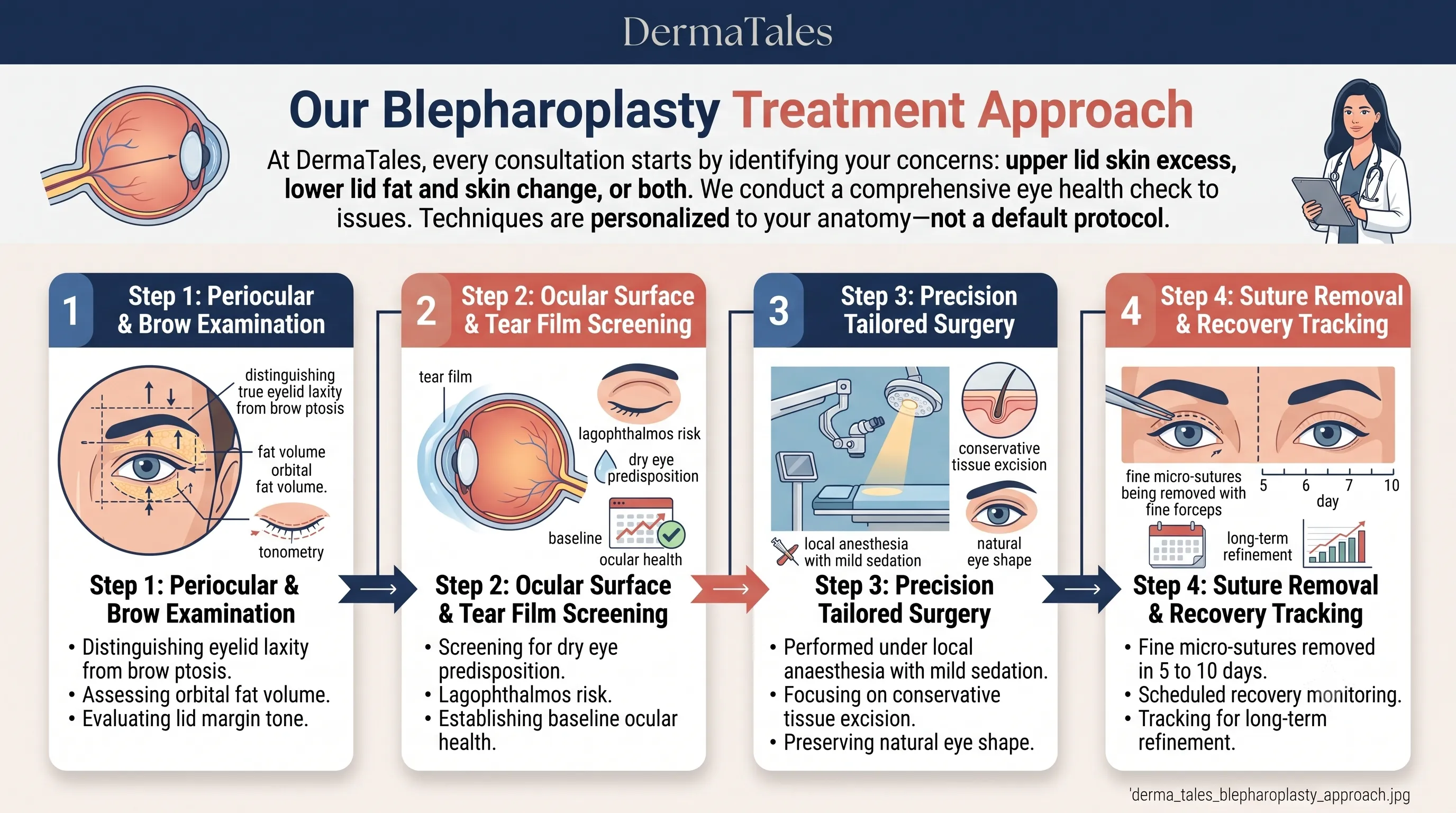
Our Treatment Approach
Every blepharoplasty consultation at DermaTales starts with identifying whether your concern is upper lid
skin excess, lower lid fat and skin change, or both, since this determines the entire surgical plan. A
basic eye health assessment, including checking for pre-existing dryness, is part of this evaluation, so
nothing is missed before surgery is planned. From there, the specific technique, whether standard skin
excision or a scarless transconjunctival approach for certain lower lid cases, is chosen based on your
particular anatomy rather than applied as a default.
Step 1: Periocular & Brow Examination
Distinguishing true eyelid laxity from brow ptosis and assessing
orbital fat volume and lid margin tone.
Step 2: Ocular Surface & Tear Film Screening
Screening for dry eye predisposition, lagophthalmos risk, and
establishing baseline ocular health.
Step 3: Precision Tailored Surgery
Performed under local anaesthesia with mild sedation, focusing on
conservative tissue excision to preserve natural eye shape.
Step 4: Suture Removal & Recovery Tracking
Fine micro-sutures removed in 5 to 10 days, followed by scheduled
recovery monitoring for long-term refinement.
Procedures We Offer
We offer targeted surgical solutions designed to match your individual eyelid anatomy:
Excess skin and muscle are removed through a fine incision hidden within the natural eyelid
crease. Lifts heaviness and eliminates tired hooding.
Incision
Natural eyelid crease
Benefit
Eliminates heavy hooding
Duration
45–60 min (Local Anesthesia)
Performed via a subciliary or internal transconjunctival approach (no external scar) to remove or
reposition herniated fat pads and tighten loose skin.
Approach
Transconjunctival / Subciliary
Benefit
Removes persistent eye bags
Outcome
Smooth lid-cheek transition
Simultaneous upper and lower eyelid refinement in a single session for comprehensive periocular
rejuvenation with a unified recovery period.
Scope
Full periocular framework
Advantage
Single recovery timeframe
Impact
Youthful, alert eye profile
For patients whose main concern is fine lines or volume loss rather than excess skin or fat, our Dermal Fillers and Botox pages cover non surgical options that are sometimes used alongside or instead
of blepharoplasty.
Cost of Blepharoplasty in Delhi
Cost depends on whether upper, lower, or combined blepharoplasty is needed, which specific technique is
used for the lower lid, and whether the procedure is combined with another treatment such as fillers or a
brow lift. Upper eyelid surgery alone is generally simpler and priced differently from combined upper and
lower correction. At DermaTales, exact costing is confirmed after your consultation and eye assessment,
once your specific surgical plan is determined.
Transparent Surgical Quotation
Following clinical evaluation of your eyelid contours, you receive a detailed quotation covering
surgical fees, local anaesthesia, post-operative medication, and all follow-up review visits without
hidden charges.
Why Choose DermaTales for Blepharoplasty in Delhi
Eyelid surgery done without properly distinguishing upper from lower concerns, or without an honest
conversation about dry eye risk, is how patients end up disappointed with an otherwise well performed
procedure.
Distinct Anatomical Mapping
Clear distinction made between upper and lower eyelid concerns before
any procedure is planned.
Dry
Eye & LASIK Screening
Pre-existing dry eye and recent laser vision correction specifically
screened for before surgery.
Scarless Lower Lid Method
Transconjunctival, scarless technique available for suitable lower
lid cases.
Honest Risk & Expectation Setting
Honest conversation about realistic risks, including dry eye, rather
than an overstated safety claim.
Patel
Nagar Central Delhi
Located in Patel
Nagar, accessible for patients across Central Delhi including Karol Bagh, Rajinder Nagar, and
Punjabi Bagh.
Results and Timeline
Swelling and bruising are most noticeable in the first week, with stitches, where used, typically removed
around five to ten days after surgery. Most patients feel comfortable returning to work within one to two
weeks, often with sunglasses to cover residual bruising in the early days.
Some degree of temporary dry eye or grittiness is common in the first days to weeks after surgery, and
generally settles as swelling resolves, though it is worth mentioning at your consultation if you already
have dry eyes. Final results settle over several months as residual swelling fully resolves, and results
are generally long lasting, with many patients seeing the benefit for five to ten years or more, since
removed skin and fat do not return the way surrounding tissue continues to age.
Days 1 – 7
Initial Healing
Peak swelling & mild bruising; cold compresses help accelerate
settling.
Days 5 – 10
Suture Removal
Micro-sutures removed; incision lines begin blending smoothly into
natural folds.
Weeks 1 – 2
Return to Routine
Bruising subsides significantly; patients comfortably return to
social & work routines.
5 – 10+ Years
Long-Term Longevity
Permanently excised fat & skin preserves a rested, youthful
periocular profile for years.
Frequently Asked Questions
Upper blepharoplasty addresses drooping or hooded skin on the upper eyelid, while lower
blepharoplasty addresses fat bulging or looseness beneath the eye, and they are genuinely different
procedures. Whether you need one or both depends entirely on which structural changes are present,
which is assessed at your consultation rather than assumed.
Some degree of temporary dryness or grittiness is a recognised and fairly common experience after
blepharoplasty, generally resolving within days to a few weeks as swelling settles. Patients with
pre-existing dry eye are assessed carefully beforehand, since surgery can temporarily worsen
existing symptoms.
This sometimes happens when the actual cause of a tired appearance was drooping eyebrows rather than
the eyelid skin itself, in which case blepharoplasty alone will not fully address it. This is
exactly why identifying the true source of the concern at consultation matters more than assuming
eyelid surgery is always the answer.
Most patients pursue blepharoplasty for cosmetic reasons, but in cases where excess upper eyelid
skin has progressed enough to obstruct peripheral vision, the procedure can also provide a genuine
functional benefit. This distinction is worth mentioning clearly at your consultation.
Bruising and swelling are most noticeable in the first week and typically improve significantly
within one to two weeks, which is when most patients feel comfortable returning to work, often using
sunglasses in the meantime. Full settling of the final result takes longer, generally a few months.
Pre-existing dry eye needs to be properly assessed before surgery, since blepharoplasty can
temporarily worsen it. Patients who have had LASIK or other laser vision correction are generally
advised to wait around six months before blepharoplasty, since recent corneal surgery affects
healing in ways that interact with eyelid surgery recovery.
There is no fixed age requirement in either direction. Some patients seek upper eyelid correction
for a genetic hooding pattern in their twenties or thirties, while others pursue it later in life
for age related changes, and candidacy is based on your actual anatomy and health rather than age
alone.
Results are generally long lasting, often five to ten years or more, since the skin and fat removed
during surgery does not return. Surrounding areas of the face continue to age naturally, which is
why some patients choose to combine blepharoplasty with other treatments over time.
TAKE
THE NEXT STEP
Book Your Blepharoplasty Consultation
DermaTales,
Patel Nagar
If tired looking eyes have not responded to non surgical treatment, an honest eye assessment can
tell you exactly which procedure, if any, is right for your specific concern. Book an
appointment with DermaTales, Patel Nagar to get started.
Scar-Hidden Inward Incisions
Ocular Surface Safety
Dermatosurgeon Supervised