Birthmark Removal in Delhi, Patel Nagar
Not every birthmark responds to the same laser, and treating a red vascular birthmark with the wrong
wavelength is why some patients see little to no improvement after several sessions elsewhere. Birthmarks
vary enormously depending on whether they are made up of blood vessels near the surface or excess pigment
in the skin, and the treatment has to match which one you actually have. At DermaTales in Patel Nagar,
Delhi, birthmark removal starts with correctly identifying the type before choosing a laser or approach,
under the supervision of Dr. Pooja Varshney, MD Dermatology.
Distinct laser wavelengths matched specifically to hemoglobin vessels
or concentrated melanin.
Pre-treatment screening ensures benign classification and rules out
underlying vascular syndromes.
Carefully calibrated fluences to safeguard surrounding Indian and
Asian skin tones against PIH.
Understanding the Type of Birthmark You Have
Vascular birthmarks, including port wine stains and some hemangiomas, are made up of a dense network of
tiny blood vessels close to the skin's surface, which is why they typically appear red, pink, or purple.
These respond to lasers that specifically target blood vessels, and using the wrong type of laser here
explains why some patients feel like previous treatment barely worked.
Pigmented birthmarks, such as cafe-au-lait spots, are caused by a concentration of pigment producing cells
rather than blood vessels, and they require an entirely different laser wavelength that targets pigment
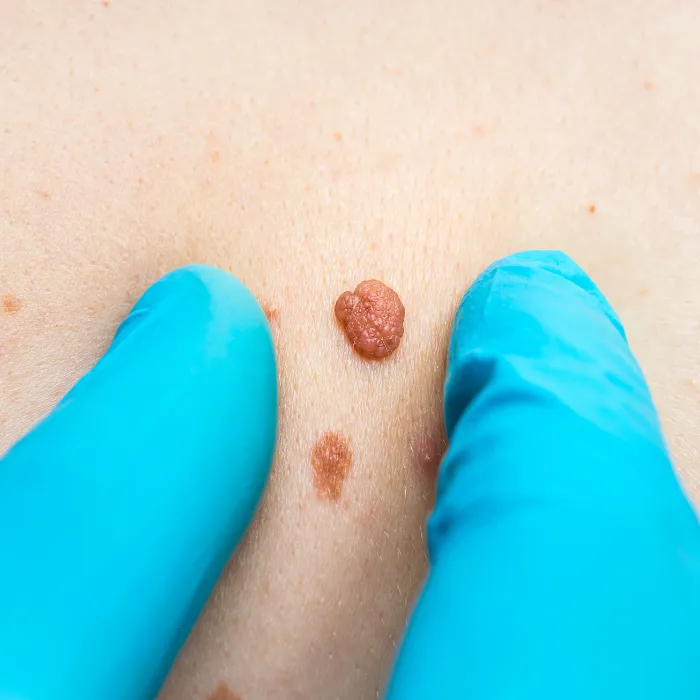
specifically. Raised birthmarks or certain congenital moles are structurally different again, and may be
better suited to surgical removal rather than laser treatment altogether.
Getting this classification right at your very first consultation is what determines whether your
treatment actually works, rather than repeating sessions with limited results.
| Birthmark Type |
Underlying Cause |
Typical Appearance |
Optimal Treatment Modality |
| Vascular (Port Wine Stain, Hemangioma) |
Superficial capillary / vessel clusters |
Red, pink, or deep purple patches |
Vascular
Targeting Laser |
| Pigmented (Cafe-au-lait, Nevus of Ota) |
Concentrated melanin / melanocytes |
Tan, light brown, or slate-grey macules |
Q-Switched
/ Pico Pigment Laser |
| Raised / Congenital Moles |
Structural cellular nevus tissue |
Elevated, textured, or fleshy lesions |
Precision
Surgical Excision / Radiofrequency |
When a Birthmark Needs Medical Evaluation, Not Just Cosmetic Treatment
Most birthmarks are entirely benign and are removed purely for cosmetic reasons, which is a completely
valid reason on its own. However, certain signs mean a birthmark should be medically evaluated before, or
instead of, cosmetic treatment. A birthmark that is growing rapidly, bleeding, changing in color or
texture, or causing pain is worth having assessed properly rather than treated cosmetically without first
understanding why.
Large facial birthmarks, particularly around the eye or forehead, are occasionally associated with
underlying conditions that benefit from a broader medical evaluation rather than laser treatment alone.
This is not meant to cause alarm, the overwhelming majority of birthmarks carry no health risk at all, but
it is worth knowing so nothing is missed.
Clinical Signs Warranting Prior Evaluation
- Rapid expansion in size or
thickness over a short timeframe
- Spontaneous bleeding, crusting,
or ulceration without external injury
- Asymmetrical shape changes,
irregular darkening, or multi-color shifts
- Periorbital or upper-facial distribution
requiring neurological or ophthalmological cross-check
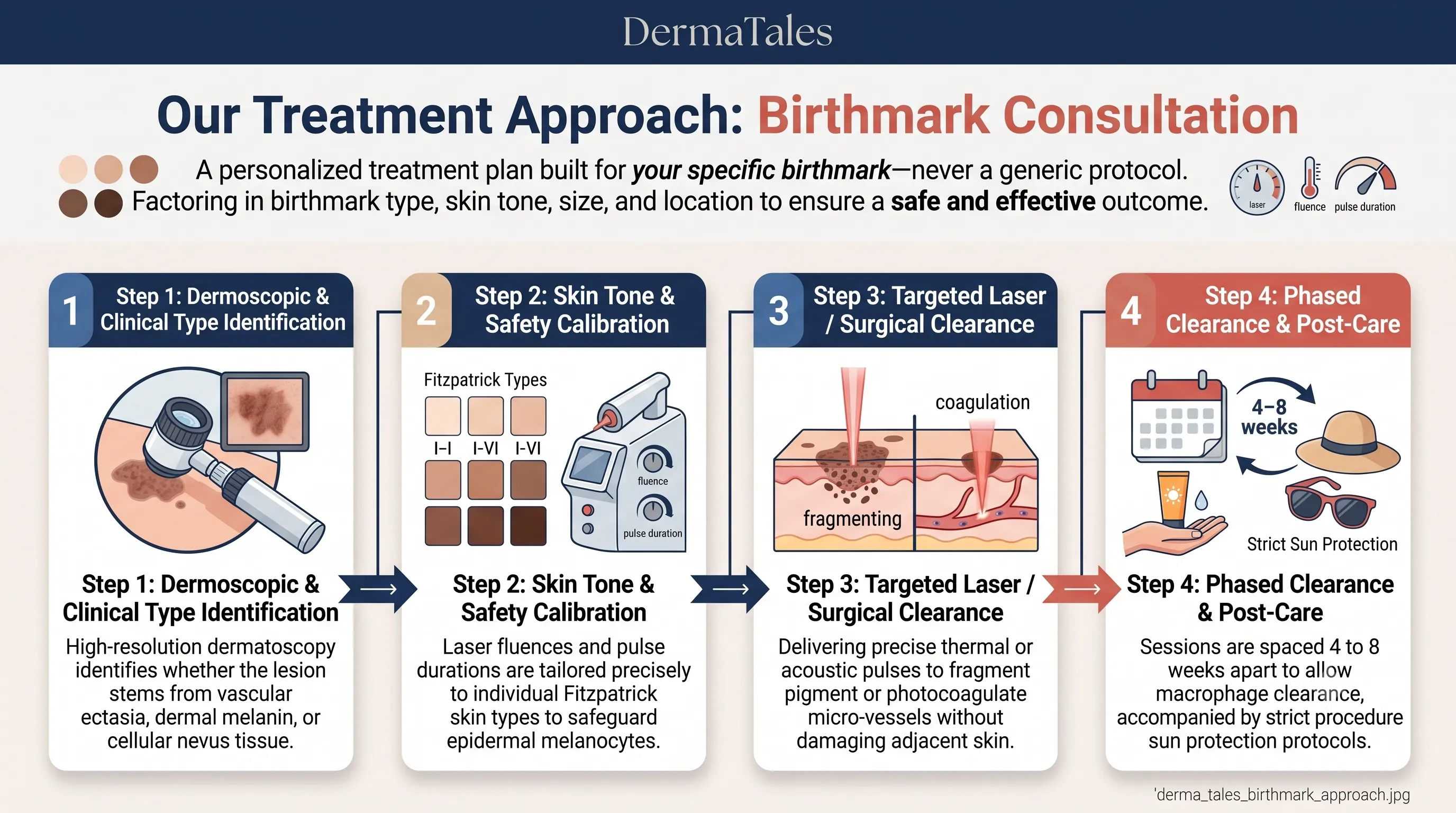
Our Treatment Approach
Every birthmark consultation at DermaTales begins with identifying exactly which type of birthmark you
have and screening for any of the signs above that would warrant medical evaluation first. Skin tone,
birthmark size, and location are also factored in, since darker skin tones need careful laser settings to
avoid pigmentation changes in the surrounding skin. From there, a session plan using the correct laser or
method for your specific birthmark type is built, rather than a generic protocol applied to every
birthmark regardless of what it actually is.
Step 1: Dermoscopic & Clinical Type Identification
High-resolution dermatoscopy identifies whether the lesion stems from
vascular ectasia, dermal melanin, or cellular nevus tissue.
Step 2: Skin Tone & Safety Calibration
Laser fluences and pulse durations are tailored precisely to individual
Fitzpatrick skin types to safeguard epidermal melanocytes.
Step 3: Targeted Laser / Surgical Clearance
Delivering precise thermal or acoustic pulses to fragment pigment or
photocoagulate micro-vessels without damaging adjacent skin.
Step 4: Phased Clearance & Post-Care
Sessions are spaced 4 to 8 weeks apart to allow macrophage clearance,
accompanied by strict post-procedure sun protection protocols.
Treatment Options We Offer
Because birthmarks originate from fundamentally different skin structures, we provide specialized,
type-specific therapeutic options:
Targets blood vessels directly, making it the appropriate choice for port wine stains and vascular
birthmarks. Multiple sessions work progressively to lighten color without epidermal harm.
Target
Capillary Hemoglobin
Recommended For
Port Wine Stains & Hemangiomas
Progression
Gradual multi-session fading
Used for cafe-au-lait spots and pigmented birthmarks. This laser targets excess melanin
specifically rather than blood vessels, using calibrated nanosecond and picosecond pulses.
Target
Melanin Chromophores
Recommended For
Cafe-au-lait & Pigmented Marks
Technology
Q-Switched & Picosecond
For raised birthmarks or congenital moles where laser is unsuitable. Allows direct excision with
fine plastic suturing to support optimal cosmetic scar healing.
Target
Elevated & Congenital Nevi
Technique
Plastic Closure & Scar Control
Outcome
Complete Single-Session Removal
Looking for other benign skin growth removals?
Explore our dedicated treatment for skin tags, moles, and viral
warts.
Cost of Birthmark Removal in Delhi
Cost depends on the type of birthmark, its size and location, and how many sessions your specific case
requires, since vascular and pigmented birthmarks are treated with different lasers and different session
counts. A small, localized birthmark costs differently than a larger port wine stain needing an extended
course of treatment. At DermaTales, exact costing is confirmed after your consultation, once your
birthmark type and treatment plan are established.
Transparent Session & Package Costing
Following clinical dermoscopy, Dr. Pooja Varshney provides a clear, written plan detailing the expected
session count and laser modality, ensuring total transparency before starting.
Why Choose DermaTales for Birthmark Removal in Delhi
Not every birthmark responds to the same laser, and a plan that does not start by correctly identifying
your specific type is starting in the wrong place.
Accurate Type Classification
Birthmark type correctly identified before choosing a laser or
approach.
Medical Safety Screening
Screening for signs that warrant medical evaluation rather than
cosmetic treatment alone.
Skin
Tone Customization
Laser settings adjusted carefully for different skin tones to avoid
pigmentation changes.
Full
Spectrum Solutions
Both laser and surgical excision available depending on what your
birthmark actually needs.
Patel
Nagar Clinic Location
Located in Patel
Nagar, accessible for patients across Central Delhi including Karol Bagh, Rajinder Nagar, and
Punjabi Bagh.
Results and Timeline
Most laser birthmark treatment requires four to eight sessions spaced four to eight weeks apart, since the
body needs time to clear treated pigment or vessels between sessions. Vascular birthmarks typically
lighten gradually with each session rather than clearing all at once, and some deeper or larger birthmarks
may not clear completely even after a full course. Pigmented birthmarks often show more visible lightening
earlier in the course of treatment. Mild redness, tenderness, or temporary lightening at the treated area
is normal in the days following each session, and this realistic timeline is discussed clearly during your
consultation so expectations are set from the start.
Sessions 1 – 2
Initial Lightening
Initial breakdown of superficial vessels or pigment; slight fading
becomes noticeable.
Sessions 3 – 5
Substantial Clearance
Deeper pigment and capillary networks break down; birthmark blends
into natural skin tone.
Sessions 6 – 8+
Maximum Refinement
Final touch-ups for lingering borders, achieving optimal aesthetic
blending.
Frequently Asked Questions
No, the large majority of birthmarks are harmless and removal is a purely cosmetic choice. Removal
is only medically necessary in the rare cases where a birthmark is rapidly growing, bleeding,
changing, or associated with an underlying condition that needs separate evaluation.
Birthmark removal can be done at almost any age, and being an adult does not make it too late or
less effective. For children, many dermatologists prefer to wait until the child is a bit older
unless the birthmark is affecting function or growing concerningly, and this is discussed
individually rather than following a fixed rule.
True recurrence after successful treatment is uncommon, though some birthmarks, particularly deeper
vascular ones, may only lighten rather than disappear completely even after a full course of
sessions. A small number of birthmarks can also naturally darken again over the years regardless of
prior treatment.
Most patients describe the sensation as similar to a rubber band snapping against the skin rather
than significant pain, and numbing cream is typically applied beforehand for comfort. Mild
tenderness or temporary redness in the treated area afterward is normal.
Laser treatment for birthmarks does not typically leave a scar when performed correctly, though
temporary redness or lightening at the treated site is expected. Surgical excision, used for certain
raised birthmarks, does leave a scar, and incision placement is planned specifically to keep that as
minimal as possible.
Most birthmarks need four to eight sessions spaced several weeks apart, though this varies based on
the type, size, and depth of your specific birthmark. This is discussed clearly at your consultation
once your birthmark has been properly assessed.
Yes, facial birthmarks are commonly and safely treated with laser, though careful technique matters
more in this area given the visibility and skin sensitivity involved. Any facial birthmark near the
eye is examined a little more carefully as part of standard practice.
Elective cosmetic laser treatment is generally postponed until after pregnancy as a precaution, even
though there is limited evidence of specific harm, simply because it is not medically necessary
during that time. This is worth discussing directly at consultation if it applies to you.
TAKE
THE NEXT STEP
Book Your Birthmark Consultation
DermaTales,
Patel Nagar
If a birthmark has never faded, or previous treatment elsewhere has not made much difference,
getting the type correctly identified is the first real step toward a treatment plan that works.
Book an
appointment with Dr. Pooja Varshney at DermaTales, Patel Nagar for a proper evaluation.
Type-Specific Laser
Medical Screening
Doctor Supervised