Beard Transplant in Delhi, Patel Nagar
Patchy facial hair is not something that fills in with time for most men, since the number of hair
follicles you have in the beard area is largely set by genetics. No amount of waiting, grooming products,
or supplements changes that. A beard transplant works differently, it physically relocates hair follicles
that are already growing successfully elsewhere on your body into the areas where your beard will not fill
in on its own. At DermaTales in Patel Nagar, Delhi, this is planned around your actual facial hair pattern
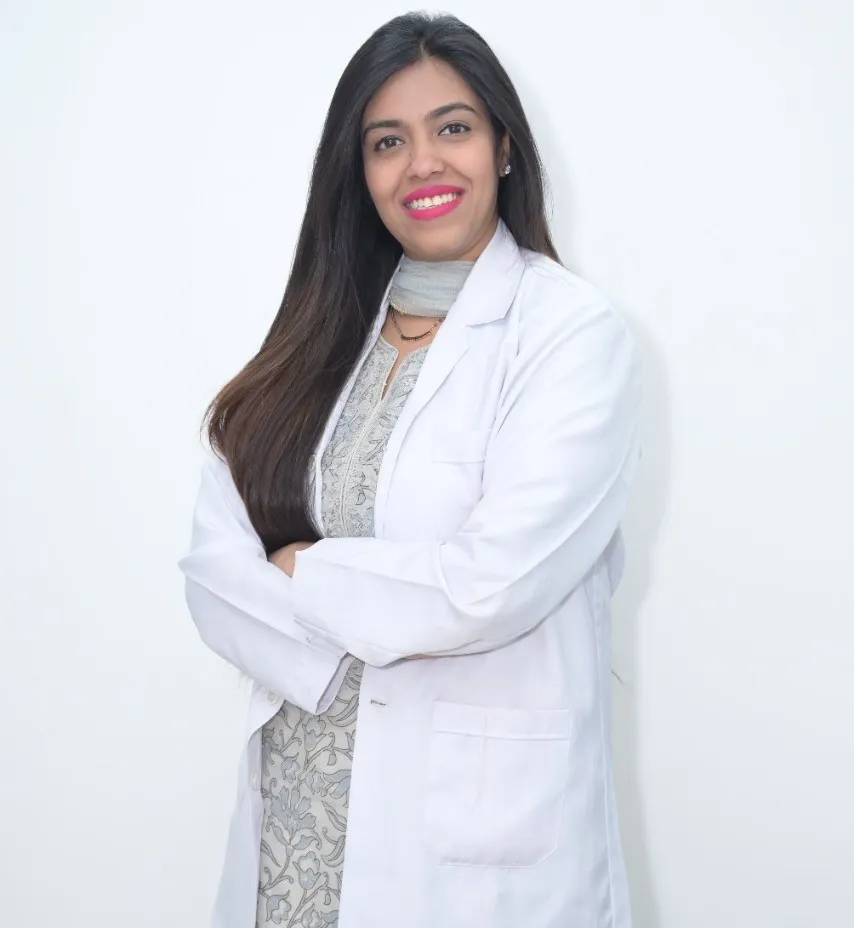
under the supervision of Dr. Pooja Varshney, MD Dermatology.
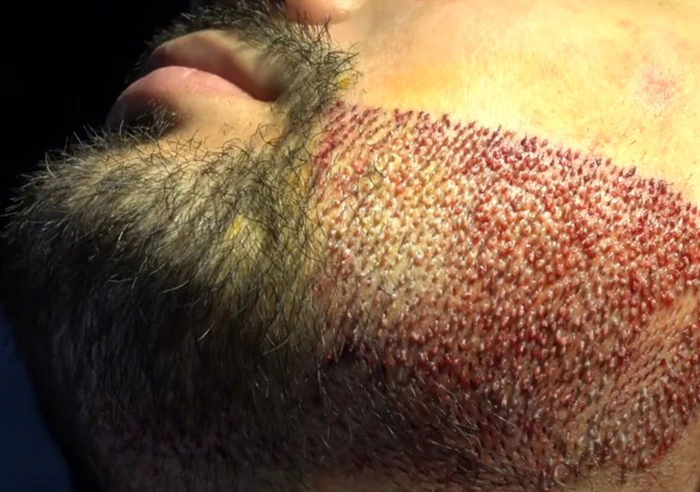
Every graft is calculated and placed around your specific patchiness
rather than a rigid, generic package.
Follicles are implanted at precise, acute facial angles to lay flat
and mirror your natural growth direction.
Advanced FUE micro-extraction harvests individual follicles safely
without leave-behind strip scars.
Why Some Beards Never Fill In
Beard density is determined by genetics and hormone sensitivity in the facial hair follicles, and both
vary significantly between individuals regardless of age, fitness, or testosterone levels. Some men simply
have fewer active follicles in certain areas of the jaw or cheek, which shows up as patchiness that stays
exactly the same year after year rather than improving.
This is different from hair loss caused by an underlying condition, and the two should not be confused.
Genuine patchy or thinning beard growth that has always been there since puberty is a good candidate for
transplantation. Sudden or recent patchy hair loss on the face is worth having assessed by a dermatologist
first, since that pattern can sometimes point to something else entirely.
| Presentation Type |
Onset & History |
Underlying Cause |
Recommended Clinical Action |
| Congenital / Genetic Patchiness |
Present consistently since puberty; unchanged over years |
Fewer active follicles in cheeks or jawline |
Ideal for
FUE Beard Transplant |
| Sudden / Acquired Beard Loss |
Sudden circular bald spots appearing recently |
Autoimmune (Alopecia Barbae) or fungal trigger |
Medical
Evaluation First |
| Trauma / Surgical Scarring |
Localized lack of growth across a visible scar |
Destruction of follicular bed from injury |
Scar-Revision
Grafting |
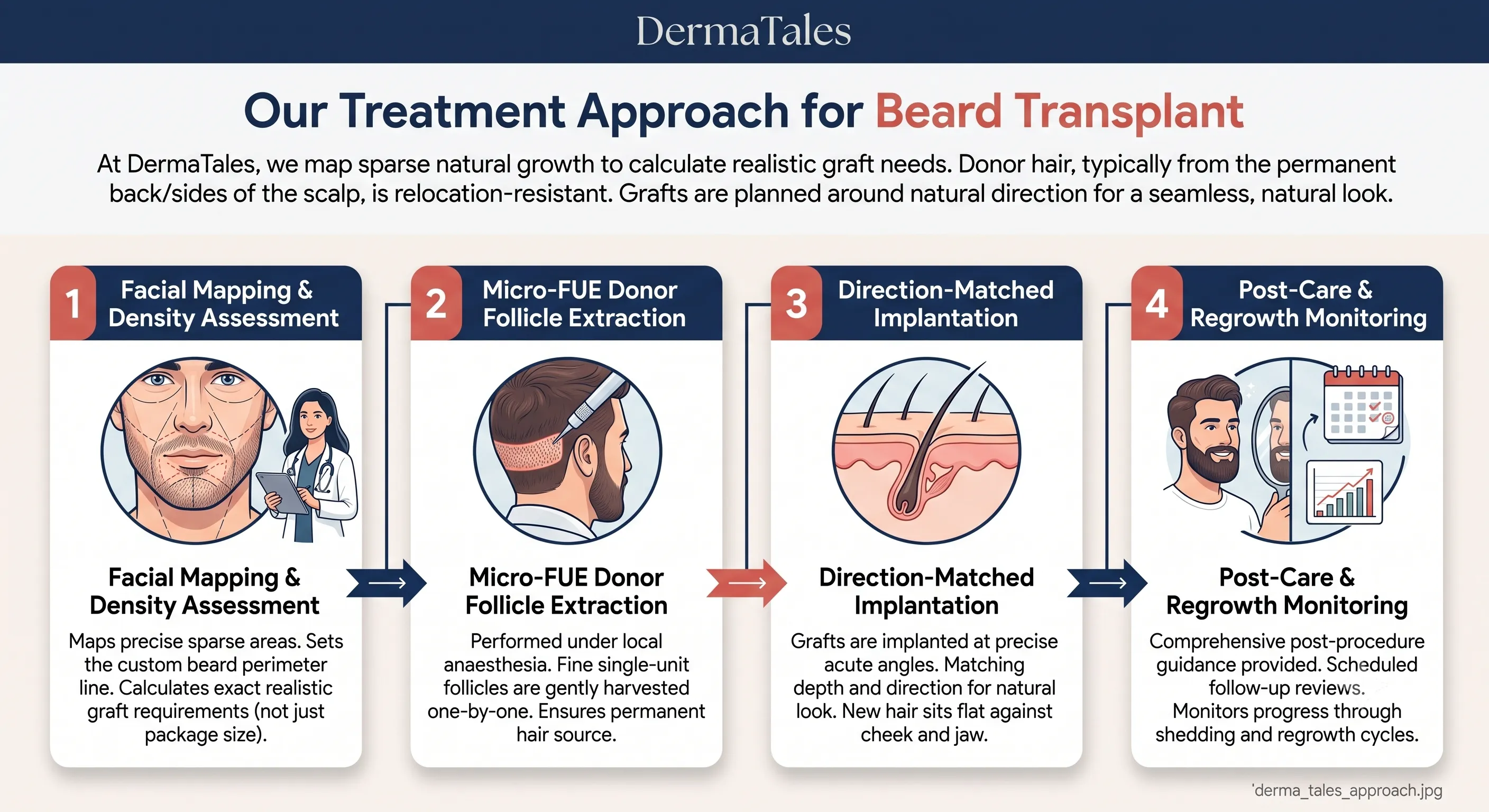
Our Treatment Approach
A beard transplant consultation at DermaTales starts with mapping exactly where your natural growth is
sparse and how many grafts that area realistically needs to look full and natural, not just how many
grafts a package includes. Donor hair is typically taken from the back and sides of the scalp, since these
follicles are naturally resistant to the hormone responsible for pattern hair loss and continue growing
reliably once relocated. Graft placement is planned around the natural direction and angle your facial
hair already grows in, since a beard transplant that ignores this detail is what makes some transplants
look obviously artificial.
Step 1: Facial Mapping & Density Assessment
Dr. Pooja Varshney carefully maps sparse zones, customizes the beard
perimeter line, and calculates the realistic graft requirement.
Step 2: Micro-FUE Donor Follicle Extraction
Under local anaesthesia, healthy single and fine-unit follicles are
gently harvested one-by-one from the permanent scalp donor zone.
Step 3: Direction-Matched Implantation
Grafts are implanted at precise acute angles and matching depths so the
emerging hairs sit flat against the cheek and jawline.
Step 4: Post-Care & Regrowth Monitoring
Comprehensive post-procedure guidance and scheduled reviews throughout
the shedding and progressive regrowth cycles.
The FUE Technique We Use
Follicular Unit Extraction is the preferred and most widely used technique for beard transplantation, and
for good reason. Individual hair follicles are extracted one at a time from the donor area using a fine
precision tool, which means no linear scar is left behind, unlike strip harvesting methods. The procedure
is performed under local anaesthesia and typically takes between three and five hours depending on how
many grafts your case needs. Extracted follicles are then placed into the beard area at a careful angle
and depth to match your natural hair growth pattern and skin tone.
Individual follicular units harvested with micro-punches (0.7–0.8 mm) from the permanent donor zone, leaving no linear scars and ensuring rapid healing.
Linear Scarring
Zero visible linear scars
Graft Selection
Single-hair facial units
Session Time
3 to 5 hours (Local Anesthesia)
Implants inserted at acute acute angles (10°–15°) flush with facial skin contours to prevent unnatural upright growth and ensure a soft transition.
Growth Angle
Acute flush-to-skin control
Density Transition
Cheek feathering to jaw density
Permanence
Permanent lifetime growth
What Recovery Actually Looks Like
Initial healing takes about seven to ten days, during which small scabs form around each graft and
gradually fall away as the skin settles. Redness and mild sensitivity in both the donor and beard area
improve steadily through this period, and most patients are comfortable resuming normal routines shortly
after.
Somewhere between two and four weeks after the procedure, the newly transplanted hair typically sheds.
This is expected and is not a sign that the transplant has failed, the hair follicle itself remains in
place under the skin, only the visible hair shaft falls out temporarily before the follicle re-enters a
new growth cycle. This shedding phase is the point where patients often worry the most, and it is worth
knowing in advance that it is a completely normal part of the process, not a complication.
New growth generally begins reappearing around three to five months post procedure, often looking fine and
sparse at first before thickening. Visible, meaningful density is typically seen between six and nine
months, with the fully mature final result taking up to twelve to eighteen months to settle completely,
which is longer than most patients expect going in.
Days 1 – 10
Initial Healing
Micro-scabbing forms and sheds naturally; donor redness clears
quickly.
Weeks 2 – 4
Temporary Shedding
Transplanted hair shafts shed as roots enter normal dormancy.
Completely expected.
Months 3 – 5
New Regrowth
Fresh beard hairs emerge fine and soft, progressively building in
thickness.
Months 6 – 18
Mature Density
Full, mature thickness and seamless blending. Shave, trim, and groom
normally.
Cost of Beard Transplant in Delhi
Cost depends primarily on how many grafts your specific pattern of patchiness requires, along with the
technique used and any combination with other facial hair restoration such as an eyebrow transplant. A
small area of targeted patchiness costs differently than a full beard restoration needing a higher graft
count. At DermaTales, exact costing is confirmed only after your consultation and graft assessment, rather
than a flat package price applied regardless of what your beard actually needs.
Transparent, Individualized Costing
During your pre-procedure evaluation with Dr. Pooja Varshney, we examine the precise graft density
required for your cheeks, goatee, sideburns, or mustache. You receive a clear, upfront estimate with no
hidden clinic charges.
Why Choose DermaTales for Beard Transplant in Delhi
A natural looking beard transplant depends on getting graft direction, density mapping, and honest
expectation setting right from the very first consultation.
Custom Graft Mapping
Graft count and placement mapped to your actual pattern of
patchiness, not a fixed package.
Scarless FUE Technique
FUE technique used to avoid linear donor scarring.
Natural Angle Matching
Growth direction and angle matched to your existing facial hair for a
natural result.
Honest Expectation Setting
Honest expectation setting around the shedding phase and realistic
timeline before you commit.
Prime
Patel Nagar Location
Located in Patel
Nagar, accessible for patients across Central Delhi including Karol Bagh, Rajinder Nagar, and
Punjabi Bagh.
For related facial hair restoration, our Eyebrow Transplant page covers a similar approach for eyebrows, and our Hair Transplant and FUE Hair Transplant pages cover the same technique applied to scalp hair loss.
Frequently Asked Questions
Yes, this is expected and happens for almost everyone, usually between two and four weeks after the
procedure. The hair follicle stays in place under the skin, only the visible hair shaft sheds
temporarily before new growth begins a few months later.
Early regrowth typically starts appearing around three to five months, with noticeable density
visible by six to nine months. The fully mature, final result generally takes twelve to eighteen
months to settle completely, which is a longer timeline than most patients expect.
FUE, the technique used for beard transplants, extracts individual follicles rather than a strip of
skin, so it does not leave a linear scar. Tiny extraction points in the donor area heal and become
essentially unnoticeable within a couple of weeks.
Yes, grafts can be placed specifically in the sparse or patchy areas while leaving your naturally
fuller areas untouched, which is why an individual graft mapping consultation matters more than a
generic package. It is also common for one side to fill in slightly faster than the other during
regrowth, which is a normal part of the healing process.
With FUE, donor follicles are extracted individually and spread across the donor area, so there is
no visible strip or line left behind. Any redness in the donor area typically settles within one to
two weeks.
Yes, since the transplanted follicles are taken from an area of the scalp that is genetically
resistant to the hormone responsible for hair thinning, and they retain that same resistance once
relocated to the beard area, continuing to grow for the long term.
FUE extracts individual follicles one at a time, leaving no linear scar, which is why it is strongly
preferred for beard transplants. FUT removes a strip of donor skin, which can achieve a high graft
yield in a single session but leaves a linear scar that is harder to conceal in the hairstyles most
beard transplant patients prefer.
Yes, though curved hair follicles beneath the skin do make extraction technically more demanding,
since the surgeon has to track the follicle's natural curve rather than remove it in a straight
line. This is why experience with curly and textured hair specifically matters when choosing where
to have the procedure done, rather than assuming any FUE trained surgeon handles it the same way.
TAKE
THE NEXT STEP
Book Your Beard Transplant Consultation
DermaTales,
Patel Nagar
If patchy facial hair has stayed the same for years despite everything you have tried, a proper
graft assessment can tell you exactly what a natural, permanent fix would involve for your
specific pattern. Book an
appointment with Dr. Pooja Varshney at DermaTales, Patel Nagar to get started.
Scarless FUE Precision
Custom Graft Mapping
Doctor Supervised